

[#1] Rethinking Safety Management Through the ETTO Principle – Overview

SAFETY MANAGEMENT · OVERVIEW
Rethinking Safety Management Through the ETTO Principle
Why “Well-Running Systems” Fail Without Warning — and What to Change First on the Floor
The ETTO Principle (Efficiency-Thoroughness Trade-Off), introduced by Erik Hollnagel in 2009, frames every operational decision as a balancing act between efficiency and thoroughness. This article uses the ETTO lens to shift the safety management perspective from an individual-error model to an operational design model. The core question is straightforward: Why don’t incidents occur only under abnormal conditions? More precisely: Why do the very adjustments that sustain normal operations become hazards at a certain point?
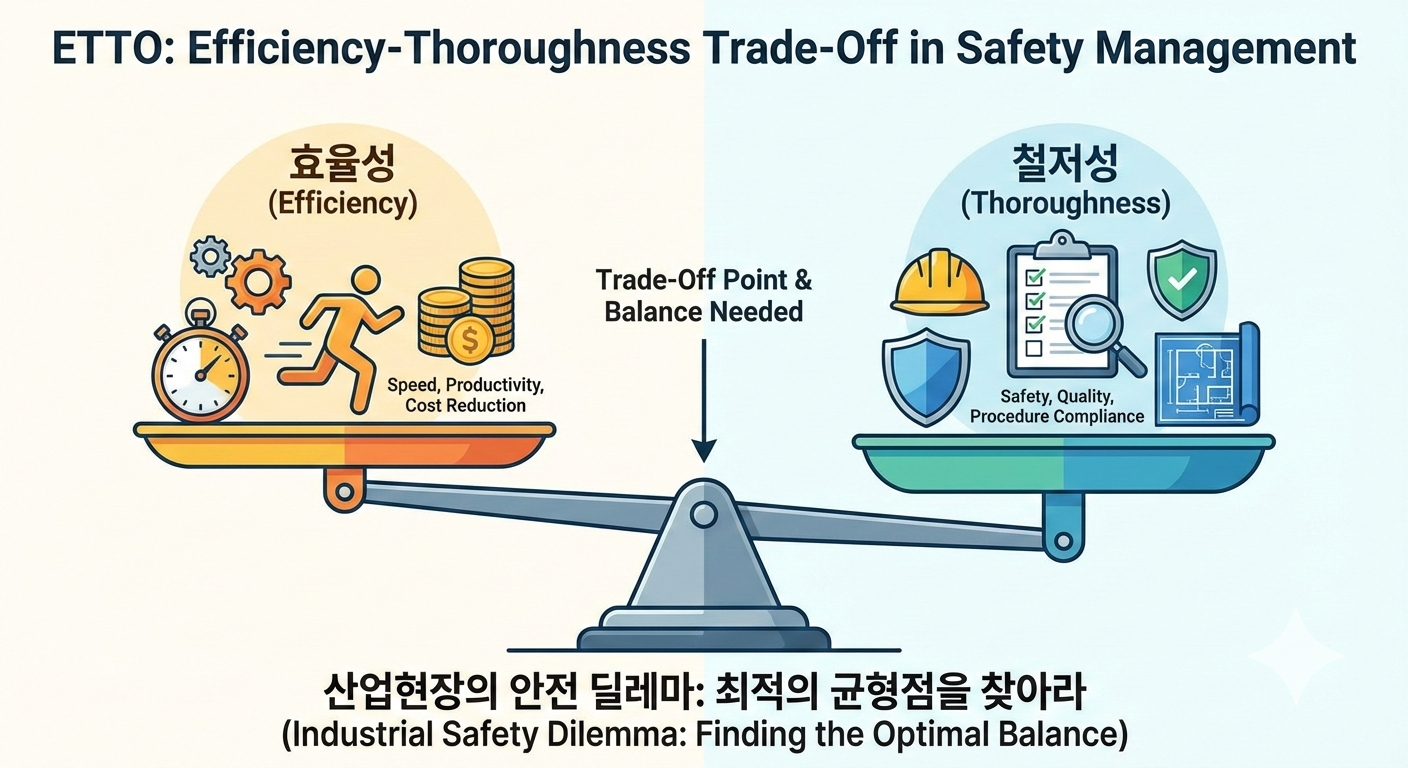
1) Why the ETTO Principle Matters for Safety Management: From Root-Cause Hunting to Condition Design
When an incident occurs, most organizations immediately try to reduce the cause to a single factor. The investigation typically concludes with “who violated the procedure,” “what mistake was made,” or “which step was skipped.” This approach looks fast and clear-cut, but it consistently sets the stage for recurrence — because operational failures rarely stem from a single cause. They are almost always the outcome of rational adjustments accumulated under constraints.
This is where the ETTO perspective begins. People and organizations always operate within limits of time, staffing, information, budget, and performance demands. Under such conditions, executing every task with full rigor is simply not feasible. In practice, operations continuously trade off between “fast enough” and “thorough enough.” The real issue is not the trade-off itself, but which conditions systematically tilt the balance in one direction. Unless we ask “why was efficiency prioritized over thoroughness this time,” recurrence cannot be prevented.
The quality of safety management is determined more by pre-incident design than by post-incident interpretation. The ETTO framework reframes incident analysis. Before assigning blame, it asks: Which KPIs were pushing the frontline to rush? Which approval structures created workarounds? Which role assignments left inspection gaps? Which scheduling pressures normalized exceptions? Without answers to these questions, organizations end up generating more reports — but not fewer incidents.
2) The Core of ETTO: Efficiency and Thoroughness Are Both Essential — But Cannot Be Maximized Simultaneously
ETTO is, as the name states, a trade-off principle. In operational settings, efficiency is often measured by throughput, speed, cost reduction, and lead time; thoroughness manifests as depth of verification, double-checks, exception management, documentation quality, and safety margins. Both dimensions are necessary for organizational survival, yet in real-world environments with finite resources, it is not possible to push both to their maximum at the same time.
Organizations therefore develop informal rules: “When pressed for time, proceed and patch later.” “This approach has worked before, so apply it the same way.” “Deadline first, review to a minimum.” These norms typically drive strong performance under stable conditions. But when added complexity, interface changes, breakdowns in coordination, or information delays converge, vulnerabilities surface quickly. In other words, failures are less a sudden disruption than the result of a previously successful operating logic running under different conditions.
This is the key insight. The ETTO principle does not argue that efficiency is bad and thoroughness is good. On the contrary — efficiency is a prerequisite for sustained operations, and thoroughness is a prerequisite for safe operations. The issue is not a moral judgment but situational fit: under which conditions should which dimension be prioritized, by how much, and by whom? And by what metrics should those adjustments be monitored? These are the design questions that matter.
3) Normal Operations and Failures Are Not Separate Worlds: The Reversal of “What Always Worked”
Many safety systems treat normal-state and incident-state as categorically distinct. The ETTO perspective, however, holds that the two exist on a continuum. The same team, the same procedure, and the same tools can produce success on one day and failure on another. What makes the difference is not individual character but small shifts in operational conditions and the accumulation of variability.
Consider a pre-task inspection that normally takes ten minutes being compressed to four under schedule pressure. The first few times, nothing goes wrong — the crew may even be praised for working more efficiently. But when task complexity increases and external variables pile up (missed shift handoffs, equipment drift, interface updates), the abbreviated inspection abruptly becomes a hazard. The surface cause of the resulting incident looks like a last-step error, yet the actual cause may be the cumulative sum of multiple ETTO adjustments made over time.
Safety management must therefore look beyond “the person on duty the day of the incident” and examine “the adjustment patterns that repeated on days when nothing happened.” This is precisely the vantage point ETTO provides — shifting incident analysis from event-centric to operational-pattern-centric so that weak signals before an incident can be detected early.
4) The Limits of the Blame Model: Why Recurrence Never Stops
Individual choices in incident investigations are certainly relevant. But when personal accountability is the sole emphasis, organizations fall into two traps. First, they miss systemic causes. Second, they degrade reporting culture. Frontline workers hide variability to avoid punishment, near misses get buried, and management receives increasingly clean numbers. In the end, the organization loses the data it needs most.
Under the ETTO framework, the question shifts — from “Who made the mistake?” to “What operational conditions made that choice look reasonable?” This reframing is not about avoiding accountability; it is about expanding the unit of accountability from the individual to the system. Unless the system is addressed, the same pressures, the same workarounds, and the same gaps will repeat.
In practice, this means revising the incident report format. Rather than forcing a single root cause conclusion, structured fields should capture contextual factors: time pressure, information accessibility, approval lead times, procedure readability, skill distribution across the crew, and interface confusion. Only when this data accumulates can repeated intervals of ETTO bias be identified and corrective actions be designed that actually reduce risk.
5) Sharp End and Blunt End: Frontline Decisions Are Shaped by Management Design
The ETTO principle does not treat the sharp end (frontline workers) and the blunt end (management) as separate domains. Workers make immediate, real-time judgments on the floor, but the direction of those judgments is set by the broader organizational system. When KPIs reward only throughput, thoroughness is perceived as a cost. When audit systems evaluate only document format, actual inspection quality becomes invisible.
Conversely, if thoroughness is demanded in policy without providing the time, staffing, and tools to support it, the frontline decouples official procedures from actual work. Documentation looks complete while operations are filled with workarounds. The system appears stable on paper, but it becomes highly vulnerable to shocks — operational changes, equipment failures, or breakdown in shift handoffs.
For this reason, ETTO-based safety management cannot stop at “more frontline training.” Performance metrics, approval structures, resource allocation, shift systems, exception-handling rules, and feedback loops must all be addressed as a single package. If you want to change frontline behavior, you must first change the conditions that make that behavior the rational choice.
6) Variability Management Is Safety Management: Incident Metrics Alone Are a Lagging Signal
Traditional safety metrics focus on lagging indicators — incident counts, injury rates, and loss severity. These are necessary, but they are slow and insensitive. Because incidents are rare events, a period of “good numbers” does not necessarily mean the operation is safe. The ETTO perspective requires monitoring operational variability that appears well before an incident occurs.
For example, the following items can serve as powerful leading indicators:
- Near-miss reporting frequency and corrective action lead time
- Trending volume and approval speed of exception requests (MOC, deviation approvals)
- Omission and abbreviation patterns in pre-task inspection checklists
- Rework rates, emergency change ratios, and missed shift handoff rates
- Field compliance rates based on direct observation — not training completion rates
This data reveals not “what went wrong after the incident” but “which balance was already tilting before the incident.” Ultimately, ETTO-based safety management is not about eliminating risk — it is about building the operational capability to detect drift early and restore balance.
7) Overview Conclusion: Safety Lives in the Quality of Decision-Making, Not in the Wording of Regulations
The ETTO principle’s greatest contribution is freeing safety management from being purely a moral issue. People are not inherently dangerous because they are imperfect. They are simultaneously the greatest risk factor and the greatest recovery resource precisely because they continuously adjust to keep complex systems running under imperfect conditions.
The right questions for sound safety management are therefore not “Should we tighten the regulation?” but rather: “Are we giving the frontline enough time to choose thoroughness?” “Are our KPIs rewarding a dangerous tilt toward efficiency?” “Are exceptions still being managed as exceptions — or have they become standard operating practice?” These must be examined first.
The purpose of this overview is not simply to introduce ETTO. Subsequent sections will cover the ETTO conceptual framework in depth, case-based interpretation, and a field application model — step by step. Specifically, tools intended for immediate practitioner use will be compiled in template form: leading and lagging indicator design, approval rule frameworks, inspection loop structures, and leadership intervention checkpoints.
In summary: safety is not “the absence of incidents.” It is the design quality of decisions repeated every day. The ETTO principle is a practical framework for measuring and improving that quality — and the starting point for organizations to intentionally manage the balance between efficiency and thoroughness.